T-00:00
Ingest Window
Operators sign in to LGL REMI, assign on-site nodes to tasks, and confirm hardware state before Relay opens ingest.
Unified Live Production Infrastructure
Ingest. Route. Mix. Record. Control. Deliver.
LGL-OS replaces scattered tools and duct-taped workflows with a single, reliable production chain. Built for teams where the signal can't go down.
New LGL REMI: remote production control for LGL-OS.
Most live environments grow organically. You start with an ingest box, add a standalone mixer, bolt on a recorder, patch in an editing tool. Each piece works on its own. But under pressure, the seams show.
Timeline offsets creep in. Recordings don't align with what the mixer saw. Extracting a clip means hunting through files with no shared reference point. Complexity scales faster than your team can manage it.
LGL-OS takes the entire live chain and puts it on a single time model with consistent operational logic. No drift, no guessing, no "it was fine in rehearsal."
Click through the media chain. Each module updates the detail panel below, while LGL REMI sits above the chain as the remote control module.
Selected step
Relay handles intake on dedicated ingest hardware and normalizes source behavior before the rest of the chain touches it.
Open Relay →The key benefit is operational sync between remote control, ingest, mixing, and output. Teams can see when a source hits the chain, and visible delay stays explicit instead of hidden.
Remote production example with LGL REMI controlling on-site hardware above the signal chain. Replace these placeholders with approved demo captures and real timing.
T-00:00
Operators sign in to LGL REMI, assign on-site nodes to tasks, and confirm hardware state before Relay opens ingest.
T+00:12
LGL REMI drives on-site ATEM, PTZ, encoder, and relay nodes from the browser while Skyline handles live mix decisions, Vault records, and LiveClip starts clipping key moments.
T+00:30
LiveClip publishes delivery-ready outputs and hands off to social, editorial, or archive destinations.
LGL-OS runs as software-defined infrastructure on hardware we operate ourselves. We use dedicated ingest hardware and custom hardware for Vault and LiveClip live-edit workflows, hosted on owned servers across two sustainable datacenters: Amsterdam and Warsaw. For now, managed hosting is EU-only and aligned with GDPR data-handling guidelines.
Need a deployment fit-check? We can map your current hardware estate to an LGL-OS rollout plan during a demo session.
Each module solves a specific production problem. Together they run on one timeline and one operational model.
Ingest Hardware + Engine
Relay combines dedicated ingest hardware with centralized ingest control and routing.
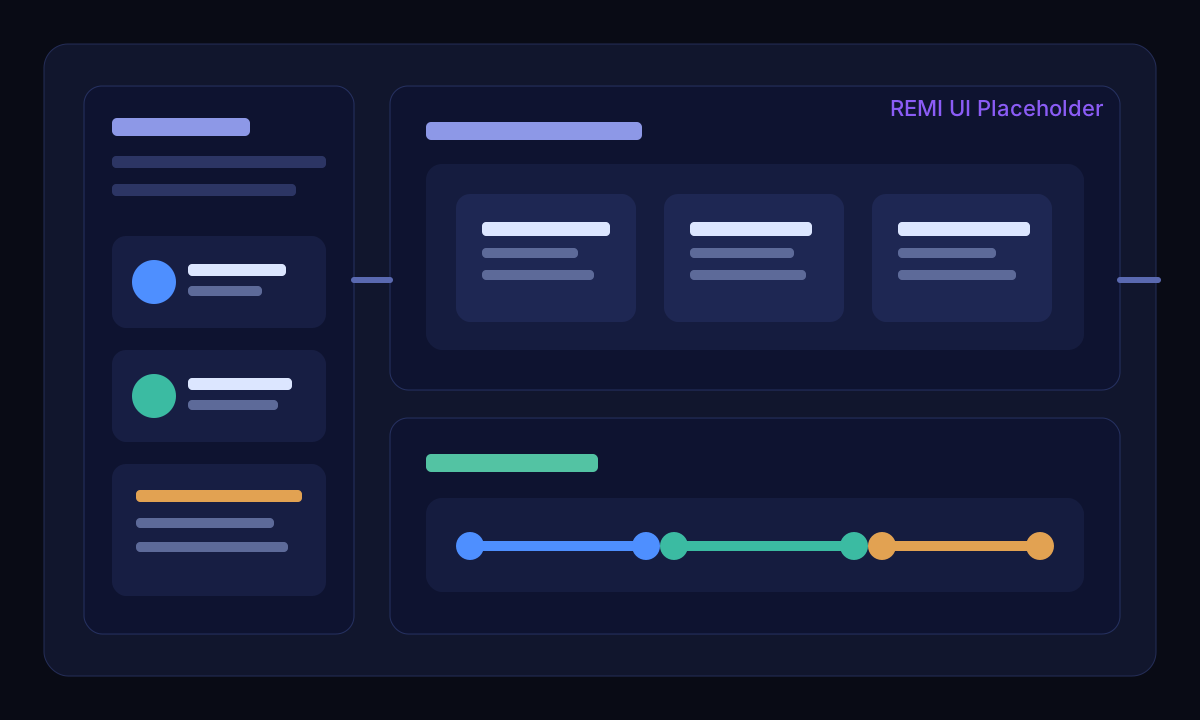
Remote Control Module
Remote production control for LGL-OS.
Cloud-Native Live Mixer
Skyline is cloud native and works with local I/O and local control panels for structured live production control.
Recording Engine
Vault records live streams on custom hardware designed for reliability, long-term storage, and frame consistency (with backup).
Clip Extraction + Live Editing
LiveClip combines clipping and live-edit workflows on one timeline model.
Release timeline
LGL REMI sits above the chain as the remote control module. Operators use it to drive on-site nodes while Relay, Skyline, Vault, and LiveClip keep the signal moving on the same time model.
Control your rack from a browser. Assign nodes to tasks, see fleet state, and drive the show live across many sites.
Pilot end Q1 · GA Q3 2026
Alpha Q3 2026
Alpha Q2 2026 · Recording + long-term storage + backup
Closed beta · Clip + live-edit workflow
Publish, handoff, archive
Real proof should live here. The blocks below are placeholders for verified customer data, logos, and deployment outcomes.
99.95% [Placeholder benchmark]
Stream continuity
< 2 min [Placeholder benchmark]
Clip turnaround
1 day [Placeholder benchmark]
Operator onboarding
"We replaced three fragile handoffs with one consistent chain. The crew stopped babysitting sync and started focusing on the show."
These are example solution packages we can offer. Final scope is shaped around your workflow, team setup, and deployment requirements.
Fast field ingest, reliable recording, and quick editorial turnaround for breaking coverage.
Distributed teams working across locations while staying on one timeline and shared control model.
Multi-camera event chains with dependable recording and fast social/editorial delivery.
Need a different setup? We can map a custom solution around your current stack and rollout constraints.
This isn't a bundle of features sold under one name. It's a system with a few properties that matter.
Teams can see when content was actually ingested and how much delay exists between ingest, editing, and output. Timing context stays explicit during operations.
What you see is what you get. The preview renderer and the export pipeline use the same source of truth. Frame for frame.
You can use parts independently, but they're designed to work together. Adding a module doesn't mean adding a workaround.
Multiple people can work across the system simultaneously without stepping on each other.
On-premise hardware, cloud infrastructure, or a hybrid of both. The system adapts to your environment, not the other way around.
We ship what works. We don't add features to fill a comparison chart.
LGL-OS is built for broadcast engineers, technical directors, live production teams, and media operations departments working in environments where "we'll fix it in post" isn't an option - because there is no post.
Multi-stage, multi-crew, no second takes
Reliable delivery, clean handoff to post
Long signal chains, high pressure, small margins
Share your current workflow and we'll map a practical rollout plan. Demo walkthrough, architecture fit, and timeline included.
Demo workflow and qualification form are placeholders and can be replaced with your CRM flow.